Southern Italian DNA and Ashkenazi Jews: Italian Jews connect the Roman and medieval evidence
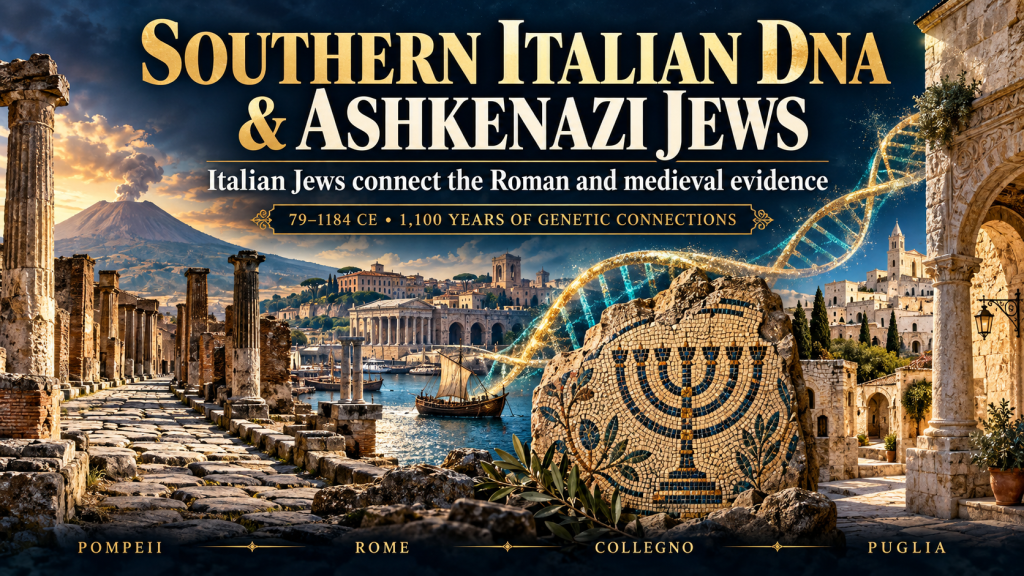
Southern Italian DNA and Ashkenazi Jews repeatedly converge around ancient Italian genomes. Adding Italian Jews to the comparison makes that relationship more revealing: some Imperial and Late Antique individuals fall especially close to Italkim and Sephardim, while others favor Calabria, Campania or Basilicata, with Ashkenazi references nearby. Across the supplied chronology, that overlapping pattern extends from Pompeii in 79 CE to medieval Puglia in 1184 CE.
The important development is the time span. We can follow related patterns through Imperial Italy, Late Antiquity and the Middle Ages. The ancient individuals vary, but Italian and Jewish affinities keep intersecting. That recurrence gives the Italian contribution to Jewish population history a concrete genetic foundation.
From the sample-size problem to a chronological comparison
My first article examined the sample-size problem: the reference collection contained 1,209 Ashkenazi samples but only nine Italki samples, alongside several small Southern Italian regional references. A tiny average should not become the basis for sweeping claims that Italian and Jewish population histories are sharply separate.
The ancient Italian comparisons across eastern and western Ashkenazim then demonstrated how the affinity survives changes in the modern Jewish reference. My R11109 paternal-lineage article added the close relationship between an Imperial Italian Y chromosome and an Ashkenazi-associated downstream branch.
This article brings those threads together with the Italki comparison. The question becomes historical: where do these related profiles appear, and how long do they remain visible?
Italian Jews match Imperial, Late Antique and early medieval Italians
The supplied Italki scan begins with a striking group. R1543, an Imperial individual from Mazzano Romano, leads at 0.02531837. Late Antique R134 follows at 0.02549897. R11117, R30, R34 and seventh-century COL_106 continue the sequence.
Ranked results from the supplied comparison. The chronology below puts the detailed cases back into historical order.
The small Italki reference remains relevant, but it does not erase the observed result: its closest supplied ancient Italian matches cross multiple centuries. The comparison repeatedly returns to the population landscape of Roman and post-Roman Italy.
Southern Italian and Ashkenazi Jews comparisons across 1,100 years
| CE | Sample / place | Italki scan | Closest supplied Southern Italian | Closest supplied Ashkenazi |
|---|---|---|---|---|
| 79 | I3691 Pompeii | 0.03437589 | Calabria 0.0499 | France 0.0423 |
| 200 | R11117 Isola Sacra | 0.02678773 | Calabria 0.0410 | France 0.0327 |
| 200 | R11109 Isola Sacra | Not supplied | Reggio Calabria 0.0418 | France 0.0519 |
| 295 | R47 Centocelle | 0.03278681 | Campanian 0.0186 | Germany 0.0241 |
| 400 | R134 Marcellino & Pietro | 0.02549897 | Calabria 0.0329 | France 0.0282 |
| 500 | R30 Mausoleo di Augusto | 0.02699320 | Reggio Calabria 0.0225 | Germany 0.0291 |
| 575 | P9898 Castel Sozzio | 0.03742654 | Campanian 0.0259 | Germany 0.0291 |
| 642 | COL_106 Collegno | 0.02729004 | Reggio Calabria 0.0233 | France 0.0262 |
| 722 | COL_136 Collegno | ≈0.04276 | Apulia 0.0232 | Belarus 0.0252 |
| 841 | TAQ003 Tarquinia | Not supplied | Molise 0.0214 | Ukraine 0.0277 |
| 950 | R1292 Rome | Not supplied | Apulia 0.0311 | Romania 0.0336 |
| 1100 | R58 Villa Magna | 0.03473800 | Basilicata 0.0189 | Germany 0.0288 |
| 1184 | VK534 San Lorenzo, Foggia | 0.03500327 | Basilicata 0.0162 | Belarus 0.0232 |
Pompeii and Imperial Rome: the Jewish-facing side of the pattern
I3691, from Pompeii’s House of the Golden Bracelet, supplies the first-century anchor. His listed modern distances favor Bulgarian Sephardim at 0.0327, Turkish Sephardim at 0.0354 and Italian Jews at 0.0355. French and German Ashkenazim follow at 0.0423 and 0.0432, ahead of the supplied Calabria and Campania references.
At Isola Sacra, R11117 sharpens that relationship. Turkish Sephardim are 0.0262 away, Italian Jews 0.0276, French Ashkenazim 0.0327 and German Ashkenazim 0.0347. His separate Italki scan distance is 0.02678773.
His ancient-reference ranking adds another connection: DEU_MA_Erfurt1 leads at 0.0277, followed by Imperial Rome at 0.0339. An Imperial Italian individual therefore approaches both modern Jewish references and a medieval Erfurt Jewish reference. The Italian-Jewish comparison reaches into the ancient reference set itself.
Late Antiquity brings Italian Jews and Calabria into the same comparison
R134, around 400 CE, is the second-closest supplied Italki match. Her website ranking places Italian Jews at 0.0258, French Ashkenazim at 0.0282, German Ashkenazim at 0.0300 and Calabria at 0.0329. Turkish Sephardim are even closer at 0.0235.
R30, around 500 CE, approaches the same overlapping populations from a more Calabrian-centered position. Reggio Calabria leads at 0.0225, Calabria follows at 0.0260, and German Ashkenazim appear at 0.0291. His direct Italki distance, 0.02699320, places him among the strongest Italki matches.
That is the connection worth emphasizing: a Late Antique Roman can be exceptionally close to Calabria while also closely matching Italian Jews and Ashkenazim. These affinities coexist within the same genome.
Collegno carries the relationship into early medieval Italy
P9898, around 575 CE, favors Maltese and Southern Italian references, with German, Belarusian, Ukrainian and Polish Ashkenazim clustered around 0.029–0.031. The transition into the medieval period retains the familiar comparison structure.
COL_106, around 642 CE, is especially important. Reggio Calabria is 0.0233 away, the website’s Turkish Jew reference 0.0239, French Ashkenazim 0.0262 and German Ashkenazim 0.0277. His direct Italki distance is 0.02729004. Seventh-century northern Italy preserves another individual connecting Southern Italian and Jewish profiles.
COL_136, around 722 CE, shifts toward Apulia and Campania, with Belarusian Ashkenazim at 0.0252. His Italki distance is farther, approximately 0.04276. The chronology therefore shows variation within the recurring relationship: the Italki and Ashkenazi comparisons do not rise and fall identically.
R30 · Rome · c. 500 CE
COL_106 · Collegno · c. 642 CE
R58 · Villa Magna · c. 1100 CE
VK534 · Puglia · c. 1184 CE
Blue: Southern Italian reference. Teal: separate Italki scan. Purple: German Ashkenazi reference, held constant across these panels. Each value retains its original comparison source.
From Tarquinia to Puglia: the medieval evidence becomes unmistakable
TAQ003, around 841 CE, favors Molise at 0.0214 and Campania at 0.0256. Ukrainian Ashkenazim and Calabria both appear at 0.0277. R1292, around 950 CE, places Apulia, Campania and Calabria first among the supplied references, followed closely by Romanian and other eastern Ashkenazim.
R58, around 1100 CE, makes the Southern Italian concentration particularly clear: Basilicata 0.0189, Calabria 0.0194 and Campania 0.0205. German, Romanian, French and Polish Ashkenazim then cluster around 0.029.
The endpoint, VK534 from San Lorenzo in Foggia, strengthens the geographic connection. This medieval individual comes from Puglia itself. His closest supplied references are Basilicata at 0.0162, Campania at 0.0178 and Calabria at 0.0196. Belarusian Ashkenazim follow at 0.0232, Polish Ashkenazim at 0.0244 and German Ashkenazim at 0.0247.
The medieval Southern Italian relationship is visible across both eastern and western Ashkenazim. An explanation based solely on eastern European admixture cannot account for that whole comparison.
R11109 adds a close paternal connection to Ashkenazi Jews
R11109 contributes a different kind of evidence. The YFull subtree places this Imperial Italian man at J-Y165124*. The Ashkenazi-associated J-Y15223 lineage descends immediately from J-Y165124, and JewishDNA.net identifies its AB-044 group with Y15223.
Shared parent structure
YF079295 · Matera, Basilicata
Italian samples from Lecco and Varese
R11109 · Imperial Isola Sacra
Ashkenazi-associated AB-044
An asterisk indicates basal or currently unresolved placement within the named clade. The diagram shows branch relationships.
The specificity matters. An Imperial Italian occupies the immediate parent clade of a lineage with an identified Ashkenazi-associated expansion. Modern Southern Italian representation appears one node farther upstream at J-Y15245*, with additional Italian carriers on a neighboring branch.
Y15223’s estimated formation is approximately 2,400 years ago; its sampled common ancestor is approximately 1,400 years ago. The ancient Italian occurrence therefore precedes the later sampled diversification. Meanwhile, R11109’s closest listed modern autosomal reference is Reggio Calabria. The paternal and autosomal evidence converge on an Italian connection.
The Natufian shortcut fails the actual comparisons
The r/JewishDNA argument challenged throughout this series turns a Natufian percentage into a shortcut for identifying recent Judean ancestry or dismissing Italian connections. The chronological evidence shows why that shortcut fails.
R11117 has 18.2% modeled Natufian and a German Ashkenazi distance of 0.0347. R47 has only 7.5% Natufian but is closer to the same reference at 0.0241. COL_106 has 8.2% and a distance of 0.0277. VK534 has 9.0% and a distance of 0.0247.
| Sample | Modeled Natufian | German Ashkenazi distance |
|---|---|---|
| R11109 | 2.7% | 0.0522 |
| R47 | 7.5% | 0.0241 |
| COL_106 | 8.2% | 0.0277 |
| VK534 | 9.0% | 0.0247 |
| R134 | 12.1% | 0.0300 |
| R11117 | 18.2% | 0.0347 |
Natufians were prehistoric Levantines. Their deep ancestry could reach later populations through several Mediterranean histories, including populations already living in Italy. The fitted component does not identify the immediate historical source. R11109 makes the distinction especially vivid: only 2.7% modeled Natufian, yet a paternal placement immediately above the Ashkenazi-associated Y15223 branch.
What the combined Italian and Jewish evidence supports
Italian Jews add an important reference between the earlier comparisons. R11117 and R134 favor Jewish populations strongly. R30 and COL_106 combine close Italki results with exceptionally close Calabrian references. Later individuals retain Southern Italian and Ashkenazi proximity even where the Italki distance increases.
The sequence supports a historically substantial Italian contribution to the formation of Ashkenazi Jews. It also places modern Italkim within a recognizable ancient Italian genetic landscape. These are related population histories whose similarities recur across individuals, sites and centuries.
Southern Italy belongs near the center of this discussion. Calabria, Basilicata, Campania and Apulia repeatedly provide the closest modern comparisons, while Italian Jewish, Sephardic and Ashkenazi references intersect with the same ancient profiles. The narrowly resolved Y-DNA relationship supplies another reason to take that connection seriously.
Sources and comparison notes
Sample metadata and website comparisons come from the collected Explore Your DNA records. The separately labeled Italki results come from the supplied Vahaduo scan against Italki_Jew_(n=9). Website “Italian Jew” distances and direct Italki-scan distances are retained as separate outputs. G25 distances measure coordinate-space proximity; lower means closer.
The chronology documents recurring profiles, rather than a pedigree connecting these particular individuals. The paternal tree establishes shared lineage structure; R11109’s personal religion and direct descendants are unidentified. These distinctions leave the central observation intact: the Italian and Jewish connections recur in the autosomal comparisons, persist into medieval Italy, and extend into specific paternal subclades.