r/JewishDNA Sample Size Problem: How Tiny Southern Italian Datasets Are Being Used for Huge Genetic Conclusions
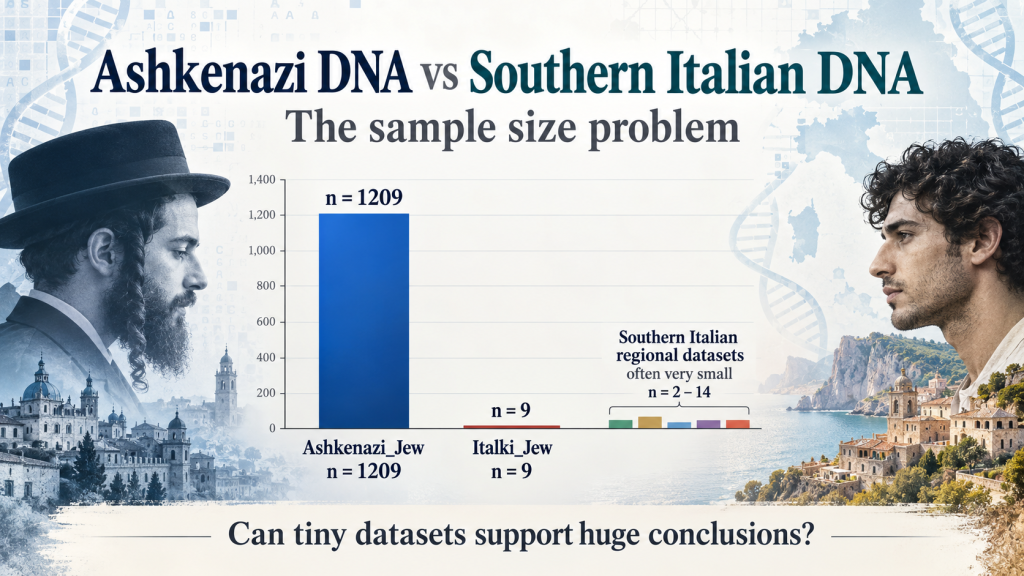
On r/JewishDNA, we often see comments arguing that higher Natufian-related ancestry in Italki Jews compared with Southern Italians demonstrates that these populations are not heavily overlapping ancestrally.
These differences are frequently presented as evidence that Italki Jews preserve a stronger Levantine-related component, while Southern Italians represent a separate ancestral history. Similar arguments are also made using Ashkenazi Jewish models.
Before drawing conclusions from ancestry percentages, the first question should be whether the underlying datasets are large and representative enough to support those conclusions.
The Moriopoulos G25 Collection 2026 – All Averages (No Sims) Dataset
This article examines the sample sizes from the Moriopoulos G25 Collection 2026 – All Averages (No Sims) dataset and compares the reference populations being used in these discussions.
The Massive Sample Size Imbalance
| Population | Sample size |
|---|---|
| Ashkenazi_Jew | n=1209 |
| Italki_Jew | n=9 |
The Ashkenazi Jewish reference contains 1,209 samples, while the Italki Jewish reference contains only 9 samples.
This is a massive difference in statistical representation. A population average built from more than one thousand individuals is far more stable than an average based on only nine individuals.
Southern Italian Reference Samples
| Population | Sample size |
|---|---|
| Italian_Apulia_(Apulian) | n=228 |
| Italian_Basilicata_(Lucanian) | n=10 |
| Italian_Calabria_(Calabrese) | n=4 |
| Italian_Calabria_(Cosentian) | n=5 |
| Italian_Calabria_Reggio_Calabria_(Calabrese) | n=9 |
| Italian_Campania_(Campanian) | n=14 |
| Italian_Sicily_(Sicilian) | n=2 |
Many Southern Italian regional references are based on extremely small samples. Some contain only a handful of individuals.
The Problem With Drawing Large Conclusions From Tiny Samples
Ancient ancestry models are only as reliable as the reference populations used to create them. When reference groups are extremely small, results can be influenced by genetic drift, founder effects, regional variation, and random differences between individuals.
A difference in modeled Natufian-related ancestry does not automatically prove separate population histories. Small reference groups can produce averages that are not representative of the wider population.
The Evidence Standard Problem
Small samples can be useful for generating hypotheses. The problem is treating tiny datasets as if they provide the same confidence as large population references.
Comparing a 1,209-person Ashkenazi reference with a 9-person Italki reference and several small Southern Italian regional samples requires caution. The size of the dataset must be considered before making historical conclusions.
Conclusion
The central issue is not simply the ancestry percentages produced by a model. The central issue is whether the datasets behind those percentages are strong enough to support the conclusions being made.
When extremely small reference populations are used to make broad claims about population history, sampling limitations and genetic drift must be addressed. The first step in evaluating a genetic argument is evaluating the quality and size of the data behind it.