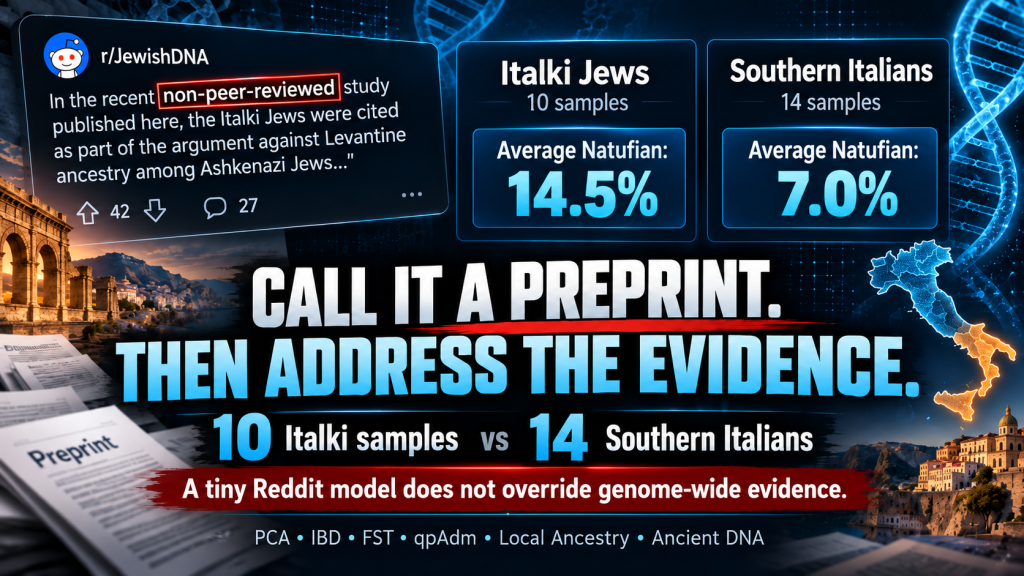
Italki Jews Natufian ancestry is at the center of a Reddit argument directed at my preprint, “How Ashkenazi Origins Were Mis-modeled: Southern Italian Ancestry, Proxy Bias, and the Illusion of Levantine Intermediacy.” The Reddit post was published by AdamDerKaiser in r/JewishDNA under the title “Neolithic model of Italkim Jews and how this does not corroborate a predominantly southern Italian origin.”
The post emphasizes immediately that my manuscript is “non-peer-reviewed.” That statement is technically correct: my manuscript is a preprint, and I explicitly identify it as such. But that description does not tell readers where the evidence discussed in the manuscript comes from. Much of the evidence examined in my paper comes from previously published population-genetic studies, while my own independent analyses are identified separately.
What AdamDerKaiser Claims
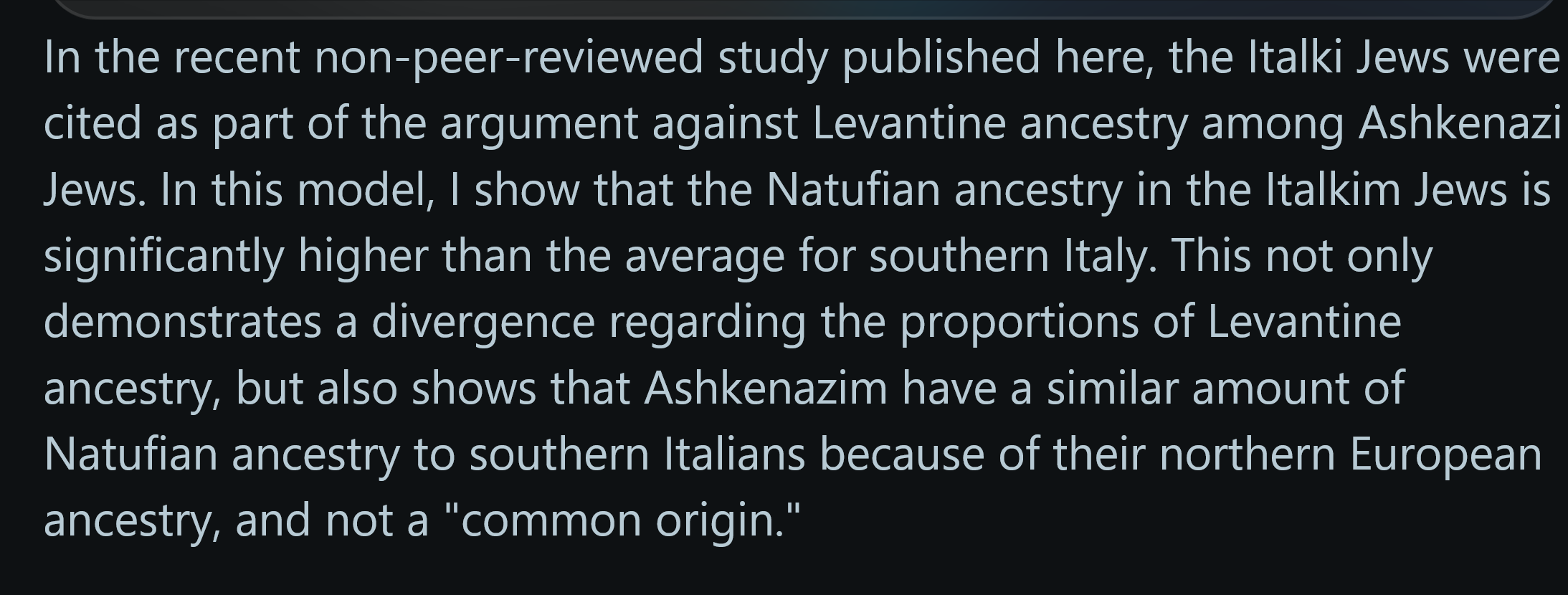
“In the recent non-peer-reviewed study published here, the Italki Jews were cited as part of the argument against Levantine ancestry among Ashkenazi Jews. In this model, I show that the Natufian ancestry in the Italkim Jews is significantly higher than the average for southern Italy. This not only demonstrates a divergence regarding the proportions of Levantine ancestry, but also shows that Ashkenazim have a similar amount of Natufian ancestry to southern Italians because of their northern European ancestry, and not a ‘common origin.’”
Look at the Dataset Behind the Claim
Before interpreting these percentages historically, there is a basic problem that deserves attention: sample size.
The screenshots presented with the Reddit argument display only 10 Italian Jewish individuals. The Southern Italian comparison displayed alongside them contains only 14 individuals: six Sicilian samples and eight Calabrian samples.
| Displayed comparison | Number of individuals | Average Natufian |
|---|---|---|
| Italian Jews (Italkim) | 10 | 14.5% |
| Sicilians + Calabrians | 14 | 7.0% |
These are the numbers shown in the Reddit author’s own screenshots. They describe the samples entered into this particular model. The much larger question is whether averages derived from 10 and 14 displayed individuals can legitimately be elevated into population-level conclusions about the ancestry and historical origins of Italian Jews, Southern Italians and Ashkenazi Jews.
The Reddit Author’s Two Models


The first screenshot reports an average of 14.5% Natufian for the 10 Italian Jewish samples. The second reports an average of 7.0% for the 14 displayed Sicilian and Calabrian samples.
The numerical difference is real within this model. But a numerical difference within a small set of modeled individuals and the historical interpretation placed on that difference are two different things.
This Is the Sample-Size Problem I Have Already Discussed
I addressed this problem separately in my previous article, “r/JewishDNA Sample Size Problem: How Tiny Southern Italian Datasets Are Being Used for Huge Genetic Conclusions.” The larger G25 collections are extremely uneven across populations and regions. Some Southern Italian regional references contain only a handful of individuals, while much larger Ashkenazi reference datasets are available.
That matters because an average from a small convenience sample should not automatically be treated as a precise estimate of an entire regional population. Southern Italy is not genetically uniform, and Sicily and Calabria themselves contain regional variation. Sampling 14 people cannot establish the complete distribution of Neolithic ancestry proportions across the populations of Southern Italy.
The same caution applies to 10 Italian Jewish individuals. An average calculated from those individuals is an average of those individuals. Treating it as a definitive population-level parameter requires evidence that the sample adequately represents the wider Italian Jewish population.
A Natufian Component Is Not a Direct Measurement of Historical Levantine Jewish Ancestry
There is a second and even more fundamental problem. “Natufian” in this type of Neolithic model is an ancient reference component. It is not a direct measurement of the percentage of someone’s ancestry that came from historical Levantine Jews.
Ancient ancestry models decompose genomes relative to selected reference populations. The resulting coefficients depend on the references and model being used. Therefore, moving from “these 10 Italian Jewish samples have a higher modeled Natufian coefficient” to “this demonstrates a different historical origin” requires an additional argument. The component label itself does not establish that conclusion.
Likewise, the claim that Ashkenazi Jews resemble Southern Italians in Natufian ancestry specifically because Northern European ancestry lowered an originally higher Natufian proportion is a historical explanation of the model, not simply a number displayed by the model. That explanation has to be tested against genome-wide evidence.
The Preprint Is Not the Same Thing as Its Sources
Repeatedly describing my manuscript as “non-peer-reviewed” does not resolve this issue. My manuscript is indeed a preprint. I make no claim otherwise. But the manuscript reviews a much larger body of published genetic evidence rather than asking readers to accept only my own calculations.
Among the studies discussed are Atzmon et al. (2010), Behar et al. (2010), Semino et al. (2004), Tian et al. (2009), Zoossmann-Diskin (2010), Schuenemann et al. (2017), Drineas et al. (2019), Waldman et al. (2022), Xue et al. (2022), Brace et al. (2022), and other published research.
The relevant scientific question is therefore not whether my manuscript currently carries the label “preprint.” It does. The question is whether the evidence and reasoning it presents are supported by the underlying studies and whether competing explanations account for that evidence better.
The 2025 Lerga-Jaso et al. Study Is Especially Important
A major piece of evidence now comes from Lerga-Jaso et al. (2025), “Tracing human genetic histories and natural selection with precise local ancestry inference,” published in Nature Communications.
This study did not use a 10-person Italki G25 model to infer Ashkenazi origins. The authors developed Orchestra, a local-ancestry inference system trained using more than 10,000 single-origin individuals representing 35 worldwide populations.
When the researchers applied Orchestra to Ashkenazi Jewish genomes, they reported approximately 68% Italian ancestry, 16.6% Levantine ancestry, 7.2% Iraqi-Iranian-Caucasian-Turkish ancestry, 2.4% Greek-Balkan ancestry, and 1.7% Eastern European ancestry.
That result is particularly relevant to the Reddit argument. A published 2025 genome-wide local-ancestry study identifies Italian ancestry as by far the largest component of the Ashkenazi genomes it analyzed. Whatever one thinks about my interpretation, that result cannot be dismissed by pointing out that my own manuscript is a preprint.
Drineas et al. Found Ashkenazi Jews Overlapping Southern European Populations
Drineas et al. (2019), “Genetic history of the population of Crete,” published in Annals of Human Genetics, provides another independent genome-wide comparison.
In the European PCA reported by Drineas and colleagues, Cretans overlapped with Peloponnesians, Sicilians and Ashkenazi Jews. The researchers also reported that both PCA and ADMIXTURE placed Ashkenazi Jews closer to Cretans than to the Palestinian and Druze comparison populations. They proposed shared Mediterranean ancestry as one possible explanation for that relationship.
This is exactly why a small Neolithic-component model cannot simply override the wider autosomal literature. PCA examines genome-wide covariance. ADMIXTURE examines genome-wide ancestry structure. IBD examines inherited chromosomal sharing. FST measures population differentiation. Local ancestry inference attempts to assign ancestry along genomic segments. These approaches are not equivalent to reading one ancient component percentage from a G25-style model.
Waldman et al. and My Independent qpAdm Experiment
My preprint also discusses Waldman et al. (2022), whose qpAdm modeling produced a model of approximately 65% Southern Italian, 19% Lebanese and 16% Eastern European ancestry.
I subsequently performed an independent qpAdm analysis. I tested Southern, Central and Northern Italian source alternatives rather than assuming that any Italian population would work equally well.
| Model | p value | Italian | Lebanese | Russian |
|---|---|---|---|---|
| Southern Italian | 0.1445 | 69.97% | 22.06% | 7.97% |
| Northern Italian | 0.0256 | 54.53% | 42.57% | 2.90% |
| Central Italian | 0.0514 | 61.33% | 33.83% | 4.84% |
My Southern Italian model was statistically feasible and estimated 69.97% Southern Italian ancestry. This is not an identical reproduction of Waldman’s point estimates, and I do not present it as one. What matters is that an independently run analysis produced the same broad structure: a majority Southern Italian component accompanied by smaller eastern Mediterranean/Levantine-proxy and Eastern European components.
That also broadly resembles the later Lerga-Jaso et al. result of approximately 68% Italian ancestry obtained using an entirely different local-ancestry methodology.
Italian Jews Were Not Introduced as a Natufian Percentage Test
The Reddit response also misplaces the role of the Italian Jewish comparison in my argument. Italian Jews were not introduced because I expected them and Southern Italians to possess identical percentages of every Neolithic ancestry component.
The comparison concerns genome-wide population relationships. My preprint discusses Italian Jewish autosomal affinity using previously published work including Atzmon et al. (2010) and Zoossmann-Diskin (2010), alongside the wider Southern European evidence.
Two populations can share substantial ancestry without having identical ancestry-component coefficients. Subsequent drift, founder effects, endogamy, admixture and sampling can alter component frequencies. Demonstrating that 10 Italian Jewish samples average 14.5% Natufian while 14 selected Southern Italians average 7.0% does not, by itself, quantify how much total ancestry the populations share or identify where the remainder of their genomes came from.
A Small G25 Model Cannot Override Genome-Wide Population Evidence
This is the central methodological problem with the Reddit argument.
We are being asked to move from a difference in one modeled Neolithic component, calculated from 10 Italian Jewish individuals and 14 displayed Southern Italian individuals, to a sweeping conclusion about the historical relationship among Italki Jews, Southern Italians and Ashkenazi Jews.
That conclusion is much larger than the dataset being shown.
Before such a result could reasonably be treated as population-level evidence, we would want substantially broader regional sampling, uncertainty around the population estimates, testing of alternative source populations, sensitivity analyses showing how the result changes when references change, and comparison against independent genome-wide methods.
Most importantly, the interpretation must account for the published evidence rather than simply replacing it. The relevant evidence includes PCA, ADMIXTURE, IBD, FST, qpAdm, ancient DNA and, now, the 2025 Orchestra local-ancestry analysis.
The Real Standard Should Be Evidence, Not Publication Labels
My manuscript is a preprint. Readers should know that, and they should scrutinize my independent analyses accordingly. But exactly the same standard should be applied to a Reddit ancestry model.
If lack of peer review is presented as a reason for caution about my analysis, then an independently produced Reddit model based on a tiny displayed sample should receive at least the same methodological scrutiny.
The appropriate response to a preprint is not to dismiss the published literature it cites. It is to examine whether the preprint represents those studies accurately, whether its independent analyses are reproducible, and whether an alternative explanation accounts for the complete body of evidence better.
Conclusion
AdamDerKaiser’s screenshots show a result worth discussing: in his displayed model, 10 Italian Jewish individuals average 14.5% Natufian while 14 displayed Sicilian and Calabrian individuals average 7.0%. I do not dispute that those are the averages displayed by his model.
What I dispute is the much larger conclusion being attached to them.
A difference between two tiny modeled samples does not establish population-wide ancestry proportions. A Natufian coefficient is not automatically equivalent to historical Levantine Jewish ancestry. And neither observation, by itself, overrides independent genome-wide evidence about the genetic relationships among Ashkenazi Jews, Italian populations and other Mediterranean populations.
Most importantly, the Southern Italian model is not something that exists only in my preprint. Published studies using different methods have produced evidence of strong Southern European or Italian affinity. In 2025, Lerga-Jaso et al. reported approximately 68% Italian ancestry in Ashkenazi Jews using their Orchestra local-ancestry framework. Drineas et al. reported Ashkenazi overlap with Sicilians, Peloponnesians and Cretans in PCA and greater Ashkenazi similarity to Cretans than to the Palestinian and Druze populations in their comparison. Waldman et al. produced a qpAdm model with a majority Southern Italian component. My own qpAdm experiment independently produced a 69.97% Southern Italian estimate under its feasible Southern Italian model.
Those results should be debated on their methods, datasets and assumptions. That is a much stronger evidentiary standard than treating the average Natufian percentage of 10 Italki samples and 14 Southern Italian samples as a population-level answer to Ashkenazi origins.