Southern Italian DNA and Ashkenazi Jews: the Y-DNA trail from Imperial Italy into an Ashkenazi branch
The Southern Italian connection to Ashkenazi Jews becomes especially striking when the autosomal evidence is placed beside the Y-chromosome tree. My currently reported paternal result is J-Y4034. Farther downstream in that same paternal structure, an Imperial-period man from Isola Sacra near Rome, R11109, is placed at J-Y165124*. Directly beneath J-Y165124 sits J-Y15223, a branch identified by JewishDNA.net as the Ashkenazi-associated AB-044 lineage.
The Italian evidence does not stop with one ancient man. A modern sample from Matera, Basilicata sits at basal J-Y15245*, immediately above the J-Y165124 branch, while another nearby branch contains additional modern Italian samples. The resulting paternal structure places ancient and modern Italian representation immediately around a later Ashkenazi-associated branch.
R11109’s whole genome strengthens the connection. His closest listed modern population is Calabria/Reggio at 0.0418, followed by Cretan Greek at 0.0441, Calabria at 0.0443 and Campania at 0.0448. Turkish Sephardim, French Ashkenazim and German Ashkenazim also appear among his closest modern comparisons. At the same time, his displayed deep-ancestry model contains only 2.7% Natufian.
That combination matters. The paternal tree places an Imperial Italian man immediately upstream of an Ashkenazi-associated lineage, while his autosomal profile is centered most closely on Southern Italy. This is much more specific than simply observing that J2 occurs among both Italians and Jews.
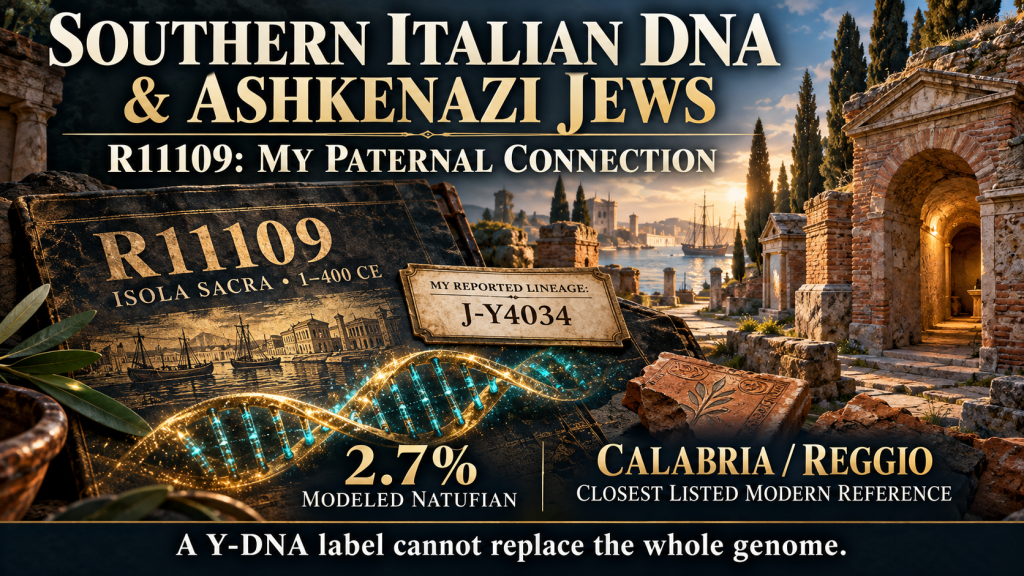
R11109: an Imperial Italian man in Rome’s harbor world
The sample catalog identifies R11109 as a male from Isola Sacra, dated broadly to 1–400 CE, with 200 CE as its summary date. His maternal lineage is X2m’n. His catalog Y-DNA is J2a1a1a2b2a2b3a2a1b. The archaeological coordinates are 41.7479, 12.2595.
Isola Sacra belonged to the Portus-Ostia harbor landscape serving Rome. The Italian Ministry of Culture describes a necropolis along the Via Flavia Severiana whose inscriptions reveal merchants, freedpeople and small business owners. This was one of Imperial Italy’s major contact zones, tied directly into the movement of people across the Mediterranean.
Antonio and colleagues’ Roman study documented substantial genetic diversity among individuals associated with the Roman world. The nearby Ostia synagogue independently documents a Jewish community in the Imperial harbor region. R11109’s personal religion is unknown, but the archaeological setting places his paternal lineage inside exactly the kind of Italian Mediterranean environment in which Italian, Greek, eastern Mediterranean and Jewish communities interacted.
R11109: the archaeological, paternal and autosomal evidence together
| Field | R11109 |
|---|---|
| Master / genetic ID | R11109 / R11109 |
| Dataset / period | Italy_RomanImperial / Roman Imperial |
| Catalog date / full dating | 200 CE / 1–400 CE |
| Location / sex | Isola Sacra, Lazio, Rome / male |
| Archaeological coordinates | 41.7479, 12.2595 |
| Catalog Y-DNA | J2a1a1a2b2a2b3a2a1b |
| Key catalog paternal path | M67 > Z1847 > Y4036 > Z467 > Z455 > L210 > Z459 > L227 > Z489 > Z482 > Y165096 > Z30386 > Y15243 > Y15222 |
| Current YFull placement | J-Y165124* |
| mtDNA | X2m’n |
| ANF | 65.3% |
| CHG / Iran Neolithic | 21.7% |
| Steppe | 10.3% |
| Natufian | 2.7% |
| Separate G25 fit | 0.0246; catalog quality label: Good |
| TUR_Barcin_N | 35.1% |
| Kura-Araxes_ARM_Kaps | 29.8% |
| TUR_Tepecik_Ciftlik_N | 24.9% |
| Yamnaya_RUS_Samara | 9.9% |
| MAR_Taforalt | 0.2% |
| Closest modern: Calabria/Reggio | 0.0418 |
| Cretan Greek / Calabria | 0.0441 / 0.0443 |
| Campania / Cypriot Greek | 0.0448 / 0.0456 |
| Sephardic Jews, Turkey | 0.0487 |
| Ashkenazi Jews, France / Germany | 0.0519 / 0.0522 |
| Druze, Israel | 0.0700 |
My J-Y4034 result and the Italian-Ashkenazi paternal connection
My consumer/chip result currently stops at J-Y4034. I have not yet taken a higher-resolution sequencing test such as Big Y-700, so my younger branch below Y4034 remains unresolved. What matters here is that Y4034 lies on the same upstream paternal structure that continues through Z489, Z482, Y15222 and Y15245 into the much narrower Italian and Ashkenazi-associated branches discussed below.
The current YFull tree places Y4034 downstream of L210. Farther down the tree, R11109 is placed at J-Y165124*, beneath J-Y15245. J-Y15223 then descends directly from J-Y165124. JewishDNA.net’s AB-044 project identifies J2a-L210-Y15223 as an Ashkenazi-associated paternal lineage.
That makes the connection exceptionally specific. R11109 is not simply another Italian man with J2. He occupies the parent clade immediately above an identified Ashkenazi branch.
My current test stops at this upstream point.
J-L210 → … → J-Y4034 → J-Z489 → J-Z482 → … → J-Y15222 → J-Y15245
The key Italian-bearing parent structure.
Southern Italian representation
YF079295 · ITA [IT-MT]
Matera, Basilicata
Basal placement
Additional Italian-bearing branch
YF112660 · ITA [IT-LC]
YF009122 · ITA [IT-VA]
Lecco and Varese
Immediate parent structure of Ashkenazi J-Y15223
R11109 · Imperial Isola Sacra
1–400 CE
Ashkenazi-associated AB-044
Formation: approximately 2,400 years ago
Sampled TMRCA: approximately 1,400 years ago
Sources: YFull J-Y4034, J-Y15222 subtree, J-Y15223 and JewishDNA.net AB-044. An asterisk marks a basal or currently unresolved placement within the named clade.
R11109 therefore provides an ancient Italian occurrence of J-Y165124*, while a modern sample from Matera, Basilicata sits at basal J-Y15245*, immediately above Y165124. A related J-Y416414 branch contains modern Italian samples from Lecco and Varese. The narrow subtree surrounding Y15223 contains Italian representation at multiple positions, including an Imperial-period Italian burial immediately upstream of the recognized Ashkenazi branch.
This is not a broad haplogroup comparison. It is a resolved phylogenetic relationship inside a much narrower paternal structure.
The chronology strengthens the connection
The chronology adds another important layer. YFull places the formation of the relevant Y15245-Y165124-Y15223 structure in the centuries before and around the beginning of the Common Era. J-Y15223 itself has a formation estimate of roughly 2,400 years ago, while the sampled common ancestor of its surviving descendants is much later, roughly 1,400 years ago.
R11109 is dated to the Imperial period, broadly 1–400 CE. His position at J-Y165124* therefore documents the parent lineage in Imperial Italy centuries before the much later sampled Ashkenazi expansion represented by the Y15223 TMRCA.
The sequence is striking: an older paternal structure is represented in Italy, an Imperial Italian man occupies the immediate parent clade, and a later downstream lineage becomes strongly represented among Ashkenazi descendants.
The modern Italian placements surround the same paternal structure
The modern YFull placements reinforce the ancient evidence. At basal J-Y15245* sits YF079295, labeled ITA [IT-MT], representing Matera in Basilicata. Another branch, J-Y416414, contains Italian samples from Lecco and Varese.
Another descendant branch runs through J-Y165124. R11109 occupies J-Y165124*, while J-Y15223 lies immediately downstream. JewishDNA.net identifies J2a-L210-Y15223 as AB-044, an Ashkenazi-associated branch. Modern descendants listed beneath Y15223 include German-labeled lines and multiple Polish, Belarusian and Ukrainian lines carrying Yiddish language labels.
The result is a paternal tree in which Italian representation is not sitting thousands of phylogenetic steps away from the Ashkenazi branch. It appears immediately around its parent structure.
The paternal evidence therefore supports a real and specific Italian-Ashkenazi connection: Southern Italian representation at J-Y15245, an Imperial Italian carrier at J-Y165124*, and an Ashkenazi-associated expansion directly downstream at J-Y15223.
Full paternal path preserved from the collected catalog record
J > M304 > M172 > M410 > CTS7683 > L26 > PF5088 > PF5125 > Z2227 > Z1846 > M67 > Z1847 > Y4036 > Z467 > Z455 > L210 > Z459 > L227 > Z489 > Z482 > Y165096 > Z30386 > Y15243 > Y15222
The current YFull tree resolves R11109 farther downstream at J-Y165124*.
R11109’s autosomal DNA independently points toward Southern Italy
The paternal evidence becomes even more important because R11109’s whole genome independently points toward Southern Italy.
His closest listed modern match is Calabria/Reggio at 0.0418. Cretan Greek follows at 0.0441, Calabria at 0.0443 and Campania at 0.0448. Cypriot Greek follows at 0.0456.
That means three Southern Italian references occupy three of the first four positions in the ranking. Calabria/Reggio is number one.
Jewish references then enter the same close Mediterranean cluster. Turkish Sephardim appear at 0.0487, French Ashkenazim at 0.0519 and German Ashkenazim at 0.0522. The western Ashkenazi placement is particularly interesting because the affinity is already visible before the eastern Ashkenazi references farther down the ranking.
Druze Israel, by comparison, is substantially farther away at 0.0700.
Selected modern references from the supplied ranking.
This is exactly why the paternal and autosomal evidence are so powerful together. The Y chromosome places R11109 immediately above an Ashkenazi-associated paternal branch. His whole genome independently places him closest to Calabria/Reggio and other Southern Italian populations.
The two lines of evidence are different, but they converge on the same historical problem: a paternal lineage associated downstream with Ashkenazi Jews is already documented in Imperial Italy in a man whose broader genome is most closely aligned with Southern Italians.
Open all 25 modern-population distances
| Rank | Modern reference | Distance |
|---|---|---|
| 1 | Calabria / Reggio Calabria | 0.0418 |
| 2 | Cretan Greek | 0.0441 |
| 3 | Calabria | 0.0443 |
| 4 | Campania | 0.0448 |
| 5 | Cypriot Greek | 0.0456 |
| 6 | Sephardic Jews, Turkey | 0.0487 |
| 7 | Ashkenazi Jews, France | 0.0519 |
| 8 | Ashkenazi Jews, Germany | 0.0522 |
| 9 | Sephardic Jews, Bulgaria | 0.0537 |
| 10 | Anatolian Greek, Kayseri | 0.0542 |
| 11 | Maltese | 0.0547 |
| 12 | Ashkenazi Jews, Romania | 0.0548 |
| 13 | Ashkenazi Jews, Latvia | 0.0563 |
| 14 | Ashkenazi Jews, Poland | 0.0567 |
| 15 | Ashkenazi Jews, Austria | 0.0579 |
| 16 | Ashkenazi Jews, Belarus | 0.0596 |
| 17 | Ashkenazi Jews, Ukraine | 0.0596 |
| 18 | Ashkenazi Jews, Lithuania | 0.0604 |
| 19 | Ashkenazi Jews, Russia | 0.0607 |
| 20 | Greek, Central Greece | 0.0622 |
| 21 | Tuscany | 0.0693 |
| 22 | Druze, Israel | 0.0700 |
| 23 | Armenian | 0.0742 |
| 24 | Anatolian Greek, Trabzon | 0.0748 |
| 25 | Karaite Jews, Egypt | 0.0749 |
Only 2.7% Natufian: why the ancestry meme fails
The Natufian result adds another important dimension. R11109 sits at J-Y165124*, the immediate parent clade of the Ashkenazi-associated J-Y15223 branch, yet his displayed Natufian component is only 2.7%.
This directly challenges the idea that Natufian percentages can be used as a simple meter of Jewishness or recent Judean ancestry. Here we have an ancient man positioned immediately above a later Ashkenazi paternal branch, yet he does not carry anything resembling an overwhelmingly Natufian autosomal profile.
Natufians were a prehistoric Levantine population. A modeled Natufian component therefore describes deep ancestry, not a direct percentage of later Jewish or Judean ancestry. The same deep ancestry could move through numerous Mediterranean populations over thousands of years.
These are deep-ancestry model outputs, not measurements of Jewish identity.
The variation alone shows why haplogroup labels cannot dictate modeled Natufian percentages. Two J1-P58 men range from 4.0% to 17.3%. R11109, despite carrying the paternal line immediately above an Ashkenazi-associated branch, sits at only 2.7%.
Two ancestry models, two different views of the same man
R11109’s displayed four-component ancestry breakdown is 65.3% Anatolian Neolithic Farmer, 21.7% CHG/Iran Neolithic, 10.3% Steppe and 2.7% Natufian.
A separate G25 fit instead produces 35.1% TUR_Barcin_N, 29.8% Kura-Araxes_ARM_Kaps, 24.9% TUR_Tepecik_Ciftlik_N, 9.9% Yamnaya_RUS_Samara and 0.2% MAR_Taforalt.
Deep ancestry components
Anatolian Neolithic Farmer: 65.3%
CHG / Iran Neolithic: 21.7%
Steppe: 10.3%
Natufian: 2.7%
Separate G25 fit
TUR_Barcin_N: 35.1%
Kura-Araxes_ARM_Kaps: 29.8%
TUR_Tepecik_Ciftlik_N: 24.9%
Yamnaya_RUS_Samara: 9.9%
MAR_Taforalt: 0.2%
Separate model outputs should not be added together. G25 fit distance: 0.0246.
No Levant_PPNB term appears in the displayed G25 solution. The important point is not that this proves an absence of all Levantine-related ancestry. It is that the same man who occupies the immediate parent clade of an Ashkenazi-associated paternal branch can be modeled without a large explicit Levant_PPNB component and with only 2.7% Natufian in the separate deep-ancestry breakdown.
That makes the equation “Jewish paternal lineage = large Natufian or Levantine percentage” impossible to sustain as a general rule.
Ancient affinities place Italy near the center of R11109’s profile
The ancient-population ranking also keeps returning to Italy. The nearest listed ancient reference is Iberia_Northeast_Empuries2 at 0.0369, but Imperial Rome follows immediately at 0.0379. Collegno appears at 0.0389, Imperial Tarquinia at 0.0404 and Mycenaean Greece at 0.0405.
Additional Italian references from Ardea, Ordona, Venosa, the Praenestini and Marsiliana appear farther down the ranking. This is a Mediterranean profile, but Italian populations repeatedly occupy some of the closest ancient positions.
Open all 15 ancient-population distances
| Ancient reference | Distance |
|---|---|
| Iberia_Northeast_Empuries2 | 0.0369 |
| ITA_Rome_Imperial | 0.0379 |
| ITA_Collegno_MA_o1 | 0.0389 |
| ITA_Tarquinia_Imperial | 0.0404 |
| GRC_Mycenaean | 0.0405 |
| GRC_Koufonisi_Cycladic_EBA | 0.0444 |
| ITA_Ardea_Latini_IA_o | 0.0447 |
| TUR_Kaman-Kalehoyuk_MLBA | 0.0448 |
| ITA_Ordona_MA | 0.0457 |
| ITA_Venosa_EMA | 0.0458 |
| ITA_Prenestini_tribe_IA_o | 0.0464 |
| TUR_Buyukkaya_EC | 0.0466 |
| ITA_Marsiliana_Imperial | 0.0468 |
| TUR_Barcin_C | 0.0470 |
| TUR_Isparta_EBA | 0.0472 |
What R11109 adds to the Southern Italian model of Ashkenazi formation
The Southern Italian case does not depend on one statistic. It comes from multiple forms of evidence lining up.
R11109 is an Imperial-period man buried in Italy. His closest modern autosomal population is Calabria/Reggio. Calabria and Campania also sit among his first four modern matches. His paternal placement is J-Y165124*, and the Ashkenazi-associated J-Y15223 branch descends immediately from that node.
One node farther upstream, a modern Southern Italian from Matera sits at basal J-Y15245*. Other Italian samples appear on a neighboring branch. Downstream, Y15223 develops into an Ashkenazi-associated lineage whose sampled common ancestor is substantially later.
That is a coherent paternal pattern: Italian representation in the parent structure, an Imperial Italian carrier in the immediate parent clade, and a later Ashkenazi expansion downstream.
The autosomal evidence points in the same direction. R11109’s genome does not place him closest to a Levantine reference population. It places him closest to Calabria/Reggio, with Calabria and Campania also among his nearest matches. Western Ashkenazim remain close enough to occupy positions seven and eight.
The combination makes R11109 particularly important to the larger argument that ancient Italian and broader Mediterranean populations contributed substantially to the formation of Ashkenazi Jews.
The Y chromosome adds something that autosomal affinity alone cannot provide: a traceable paternal line. Here that line can be followed from an Italian-bearing ancestral structure through an Imperial Italian sample and directly into a later Ashkenazi-associated branch.
My paternal history therefore cannot be reduced to the slogan “J2 equals Middle Eastern.” The actual downstream tree is far more specific. The lineage is documented in Imperial Italy, remains represented among modern Italians in the surrounding branches, and leads directly into an Ashkenazi-associated paternal expansion.
This does not stand alone. It joins the repeated Southern Italian autosomal affinities already visible across multiple ancient individuals and across different paternal and maternal lineages. R11109 adds the paternal component to that broader pattern.
The larger picture: Southern Italy is not incidental
The strongest interpretation of R11109 is not that one man proves the entire origin of Ashkenazi Jews. The importance lies in how many independent observations point in the same direction.
His archaeological context is Imperial Italy. His closest modern autosomal comparison is Calabria/Reggio. Other Southern Italian references dominate the top of his ranking. His paternal line sits inside an Italian-bearing Y-DNA structure. An Ashkenazi-associated lineage then branches immediately downstream from his own YFull placement.
At the same time, his modeled Natufian ancestry is only 2.7%, demonstrating how misleading it is to treat one deep-prehistoric component as a direct measurement of later Jewish ancestry.
The emerging pattern is therefore much more interesting than the old shorthand. Southern Italian and Ashkenazi genetic connections appear simultaneously in the autosomal record and in narrowly resolved paternal phylogeny.
There is substantial smoke here, and the Y-DNA tree gives us a concrete reason to investigate the Italian contribution seriously. The connection is not based merely on broad Mediterranean similarity. It reaches down to specific paternal branches whose ancient and modern placements intersect directly with Italy before a later Ashkenazi-associated expansion.
Sources, coordinates and reproducibility
The primary study associated with R11109’s catalog entry is Antonio et al. (2024), Stable population structure in Europe since the Iron Age, despite high mobility, eLife 13:e79714.
Explore Your DNA’s R11109 record provides the sample metadata, scaled G25 coordinates, ancestry-model outputs and modern and ancient comparison rankings used throughout this article.
YFull J-Y4034, the J-Y15222 subtree and J-Y15223 provide the paternal topology discussed here, including the Italian placements and R11109’s position at J-Y165124*.
JewishDNA.net AB-044 identifies J2a-L210-Y15223 as an Ashkenazi-associated paternal lineage.
G25 distances are coordinate-space comparisons rather than ancestry percentages. The deep-ancestry and G25 source models are separate modeling systems and should not be added together. My personal J-Y4034 result also remains the present resolution limit of my own paternal test.
None of those methodological distinctions changes the central paternal observation: modern Italian representation appears in the J-Y15245 structure, Imperial Italian R11109 sits at J-Y165124*, and the Ashkenazi-associated J-Y15223 lineage descends directly from J-Y165124. Combined with R11109’s Southern Italian-centered autosomal profile, that is a specific and compelling Italian-Ashkenazi genetic connection.